





Smart leak management at Dala Vatten och Avfall
Dala Vatten och Avfall (DVA), a Swedish water and wastewater utility covering four municipalities, has taken a big step towards a more data-driven and proactive business by combining smart metering technology with organisational changes.
.jpg?h=1000&iar=0&w=800)
Hourly values from 98% of meters

120 leaks discovered
The challenge: From limited insight to a better overall picture
DVA manages approx. 40,000 customers in a widespread supply area with 20 waterworks covering a 3,000-km water network. Historically, the’ve been monitoring the water supply, but due to variations caused by holiday homes and tourism, analyses became more difficult and created uncertainty about normal levels.
Other challenges included:
- Consumption matters that needed to be sorted out without historical consumption data
- Missing or incorrect meter readings
- Refunds and corrections of wrong invoices
The need for a more reliable, data-driven model became increasingly clear. DVA started researching modern metering solutions and conducted a pilot project with flowIQ®, a meter with built-in Acoustic Leak Detection able to detect leaks before the meter. The pilot clearly showed the potential — but also an important insight: the true value of the technology could not be fully exploited without new ways of working.
.png?mw=672&mh=672)
The solution: Implementing smart metering and adapting the organisation
DVA decided to implement a holistic change where both technology and working methods were developed in parallel. On the technology side, the project involves a gradual rollout of 17,500 digital flowIQ® meters until 2029. At the same time, an internal project organisation was established to drive the change journey.
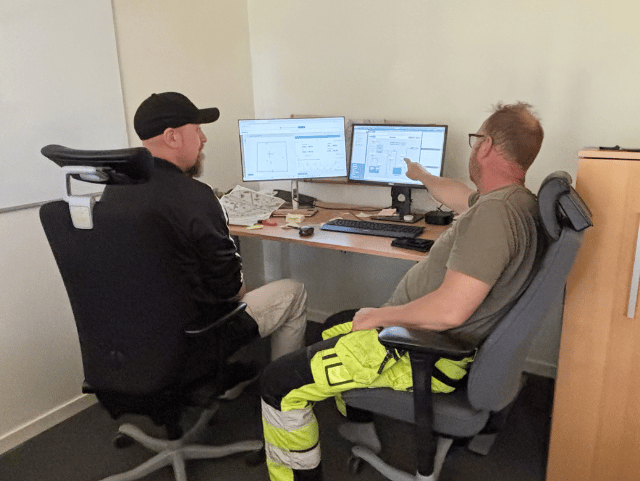
Although the full meter rollout is far from complete, DVA's organisation-wide adaptation to smart metering has already started to yield results. As Eric explains, "The biggest driver is commitment. My colleagues are competent, motivated, and work more proactively."
Eric continues: "With the help of dedicated and competent employees, we have already located many water leaks, reduced water loss, and taken great steps on our journey of change."
.png?mw=672&mh=672)
Hybrid communication solution for a widespread supply area
To ensure a robust communication setup, Kamstrup introduced linkIQ® in densely populated areas and a hybrid solution combining linkIQ® and NB-IoT in rural areas, providing full coverage and reliable data communication throughout the network.
By mid-2026, DVA had installed around 7,000 smart meters with Acoustic Leak Detection and continues to replace up to 4,000 meters per year. The results demonstrate how well DVA has managed the transition to smart metering:
- 98% of meters deliver hourly readings
- Around 120 leaks discovered so far
- About 50 of them in their own distribution network
- Around 90 fixed leaks
The result is increased security of supply, reduced water losses, and clear environmental benefits – with better control, faster response time, and a high level of engagement.