
SAV installs the world's first 2-way heat network to control consumer access - wirelessly
SAV Systems, in partnership with Metropolitan and Kamstrup, deployed a wireless heat network on the novel OMS LPWAN Burst Mode technology, with 2-way valve control in low-density UK housing. The solution meets UK regulatory (HNTAS) demands for 30-minute data, offers up to 100% service level agreement (SLA) on data collection, max 15-minute valve on/off latency, and avoids telecom technology phase out risks. Using Kamstrup’s MULTICAL® 603 meters, READy 2M concentrators, and READy Manager software, the system delivers plug-and-play installation, low total cost of ownership, and open-protocol flexibility. This innovation supports the UK’s green energy transition and sets a new standard for PAYG heat metering.
The results:
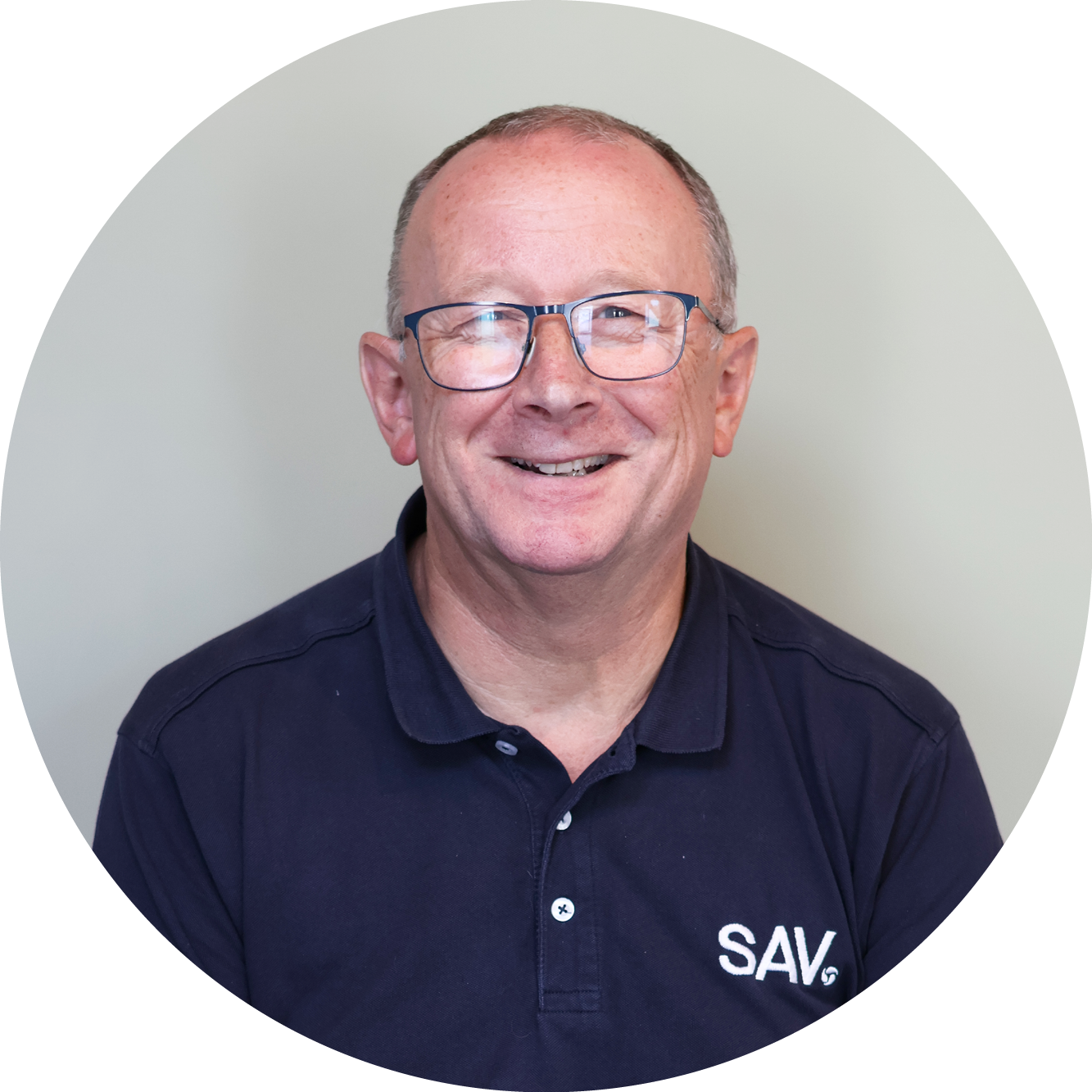
The first OMS LPWAN wireless two-way metering solutions developed by SAV have been installed in the UK, and according to Douglas Norton, Product & Technical Manager at SAV Systems, they are providing reliable performance – and were very easy to install.
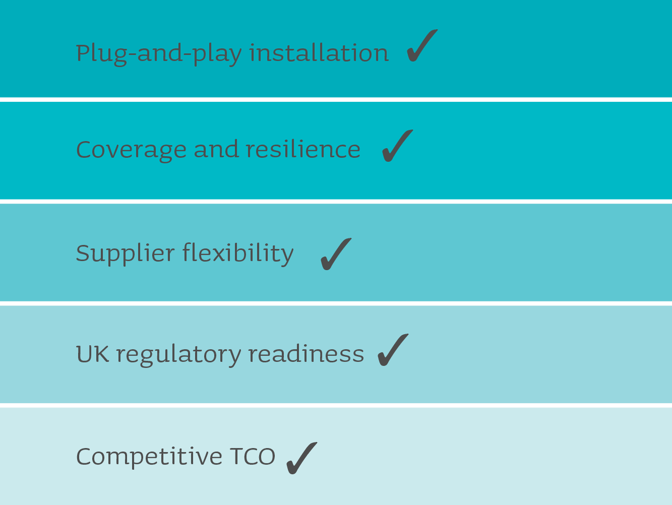
Highlighted results of the project:
- Plug‑and‑play installation: The MULTICAL® 603S is easy to install and connects via the concentrator to READy without complex router/port setups.
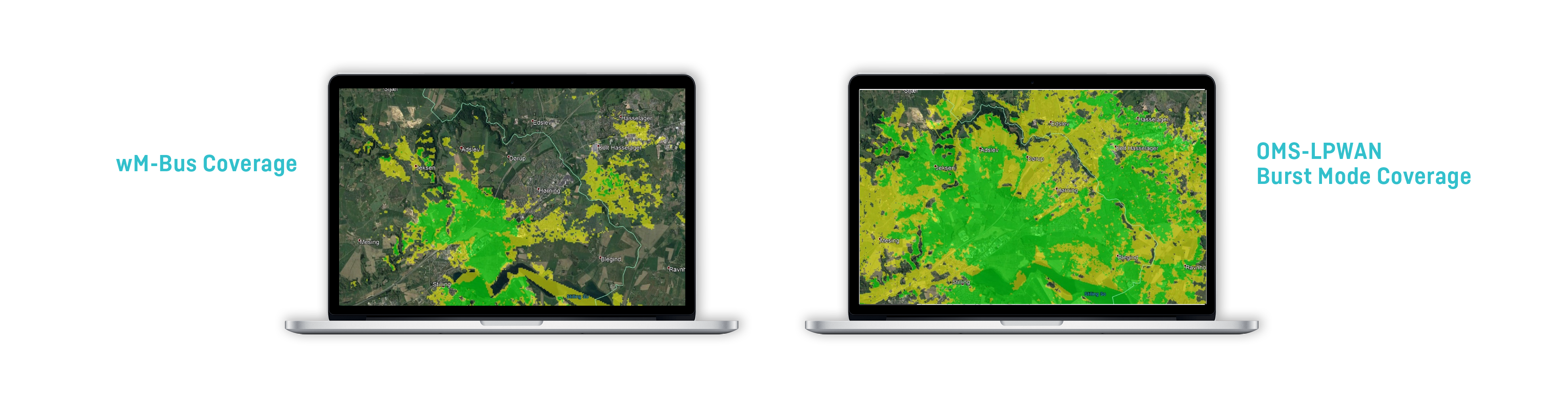
- Coverage and resilience: OMS LPWAN Burst Mode offers 4–5 times better coverage than the legacy wireless M‑Bus enabling data collection from thousands of meters per concentrator. Designed to deliver effectively PAYG availability very close to 100%.
- Supplier flexibility: Open protocol solution preserves data ownership and the right to change vendor (billing, metering, software).
- UK regulatory readiness: Supports 30‑minute consumption data to align with the preliminary HNTAS regulations.
- Competitive TCO: Fewer concentrators, simplified installation and one software platform to manage, collect data and connect/disconnect valves from the SAV office.
Douglas Norton praises the development process behind the SAV solution.
“Kamstrup have definitely engaged with us very well,” he remarks. “They listened to what we need, for example the consumer bypass which they would never have put in if they weren’t working with the UK market. We’ve been having weekly meetings with them on updates and progress. Our cooperation on this project has been brilliant.”
What is OMS and OMS LPWAN Burst Mode?
Open Metering System (OMS)
OMS is a nonprofit consortium of +70 manufacturers, utilities, and tech firms focused on developing and promoting the Open Metering System (OMS) - a vendor-independent communication standard for smart metering. OMS integrates consumption data across electricity, gas, heat, and water, including submetering, into a single interoperable system based on the M-Bus standard.
Read more about the OMS Group on their website here.
OMS LPWAN Burst Mode
OMS LPWAN Burst Mode is a low-power wide-area network (LPWAN) communication technology developed by OMS and publicly available as part of the OMS specification. It has been specifically developed for metering. It introduces 2-way communication and offers an unrivaled combination of:
- High performance:
- Up to 100% SLA - depending on the applied infrastructure
- 2-way latency of 15 minutes in mains powered cases
- High security: Based on the advanced encryption standard (AES) using OMS Security Profile D. Commands are further secured by applying an additional layer of security
- Interoperability: OMS Generation 5 communication protocol
- 2-way communication:
- Valve control: Ability to open and close valves at the installation remotely
- Clock Adjustment: The concentrators automatically adjust the meter clock to always be accurate
- Low power consumption: Low power transmission and low transmit duty cycle enables a +16 year battery lifetime
- Low total cost of ownership: More than 20 dB (equals x100 times) better reception sensitivity than wireless M-Bus Mode C resulting in more than 5 times better coverage

The challenge: A wireless 2-way communication solution with open protocol to control heat-access
SAV and its sister company KURVE already offer a wired open-protocol PAYG solution that provides metering and thermal disconnect over a wired M-Bus network. However, wired solutions are not well suited for low-density homes such as detached or semi-detached houses, cottages, and bungalows.
“For heat networks to become serious in the UK, we need to offer a solution for low-density homes,” says Douglas Norton. “When it comes to metering low density networks, a key part of the solution is the billing and monitoring of these schemes. Wired M-Bus has been the preference for a long time in the UK, but the problem is that you cannot run a cable between every single low-density home. We needed a wireless solution to be able to do the connect/disconnect control.”
The available open wireless M-Bus solutions did not offer 2-way communication to control the valve, and its TCO was not acceptable either for the network with its limited range.
A key consideration was avoiding the risk of having to replace all communication modules or meters due to technology phase-outs, as the hardware is expected to last 15–20 years. This risk is particularly high with telecom-based technologies like 4G or NB-IoT if the network operator decides to retire the technology within that lifespan. On top of this, the upcoming UK HNTAS regulation further increased requirements by mandating 30-minute data from each customer installation.
All in all, the SAV – Metropolitan project required:
- A wireless dedicated network solution
- 2-way communication to open/close the valves with max 15 min latency & close to 100% uptime
- 30-minute data from all meters with a minimum of 98% SLA on data collection
- Low TCO by covering 100-1,000 metering points pr. data collector/concentrator
- Open communication protocol
- Plug & play installation
- One software platform to manage both wired and wireless solutions

The solution: OMS LPWAN Burst Mode with 2-way communication
The solution was built on Kamstrup products, reflecting SAV Systems’ long-term partnership with Kamstrup and their shared history in innovative data collection projects. The compact, plug-and-play SAV solution combines the benefits of PAYG with the convenience of wireless connectivity, delivering great performance. It provides 4–5 times better coverage than wireless M-Bus solutions, with a range of up to 5 kilometers and a service level agreement (SLA) of 98%. This high level of reliability significantly reduces the number of concentrators required, which in turn lowers both installation and ongoing network costs.
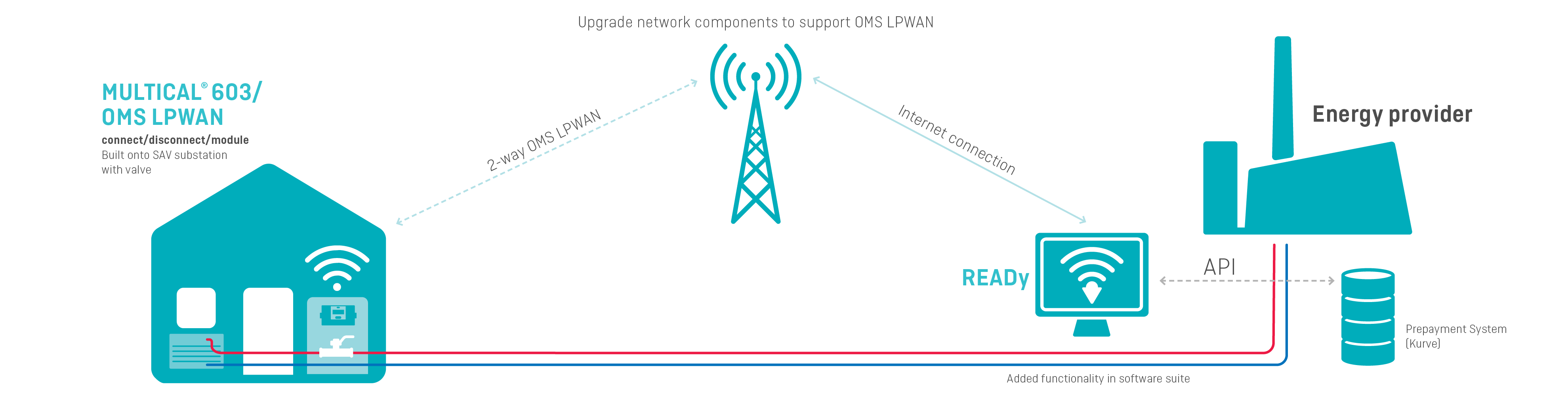
The wireless two-way SAV solution consists of:
- Meter: MULTICAL® 603S with OMS LPWAN communication module & Thermal Disconnect
- Concentrator: READy Concentrators w OMS-LPWAN
- Software: READy Manager with 2-way Add-On
Communication technology: OMS LPWAN Burst Mode – Multi-Burst
At the heart of the solution lies a new game-changing innovation for heat meters. The devices implement OMS LPWAN Burst Mode, a state-of-the-art communication technology defined in the 5th generation of the OMS specification which allows reliable data transfer from meters and concentrators and lets SAV operate HIU (heat interface unit) valves remotely.
OMS LPWAN is not dependent on telecom towers, SIM cards, or other proprietary devices or technologies that could be phased out prematurely by any controlling vendor. In addition, the technology gives building owners full control of their data and the ability to switch billing, metering, and software companies; a fact that was very important to SAV and their customers.
The UK market – a context to the project
SAV Systems Ltd, a UK leader in heat network metering, partnered with Kamstrup to develop a two-way wireless metering solution for PAYG (pay-as-you-go) heat network installations. The two companies worked closely together with Metropolitan, a provider of low-carbon heating, hot water, and cooling networks for new residential developments across the UK. Metropolitan designs, installs, owns, and operates community heat hubs and network infrastructure. They partner with SAV Systems on the heating solutions.
UK heat delivered via networks is projected to rise from ~12.9 TWh (2020) towards ~95 TWh by 2050. (Source: GOV.UK) Heat networks are an important part of the UK government’s plan to reduce carbon emissions and cut energy consumption. The networks can provide low-emission heating from a variety of sources, making them an attractive alternative to technologies such as gas boilers, and an obvious solution for lowering the nation’s climate impact.
How does pay-as-you-go work?
Under a PAYG scheme, consumers pay in advance, enjoying access to heat as long as they have sufficient credit. If they don’t, the billing company can turn off the heat by remotely operating a valve in the consumer’s HIU (heat interface unit) until the consumer has topped up the account again.
PAYG is common in the UK and has proved to be an efficient way of reducing utility debt and consumer energy usage. In fact, learnings from several PAYG schemes show that consumers can save up to 20% more energy than credit billed users because they are more engaged with their heat usage. SAV offers their PAYG solution through their sister-company KURVE.
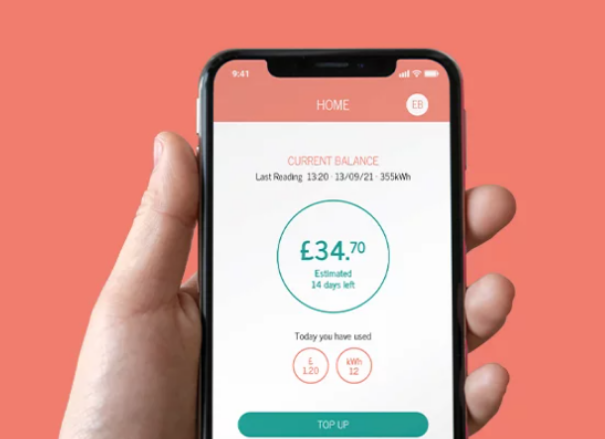
Photo: Kurve Technologies innovative and market-leading Pay-As-You-Go app that’s the software behinds SAVs offering
Meter: MULTICAL® 603S with OMS LPWAN Burst Mode
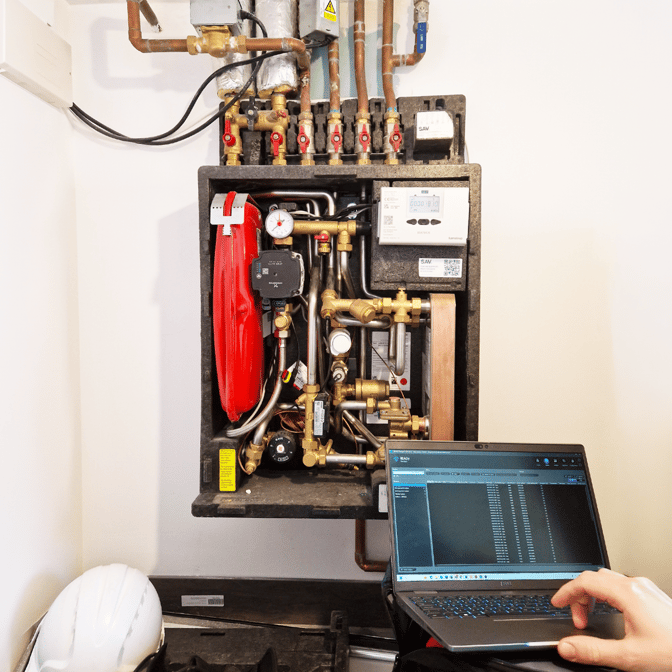
The Kamstrup MULTICAL® 603S meters are installed in the HIUs at the SAV factory before being shipped to the installation site. Having the metering solution pre-installed in the HIU prior to getting to site allows for the PAYG valves and meter to be integrated in a controlled and tested environment. This means that on site, the installer only needs to do simple HIU connections to get the metering system up and running.
Each meter includes the newly developed OMS LPWAN Burst Mode communication module, which can also send signals to SAV’s relay to connect or disconnect the supply at each installation—providing the required functionality for SAV’s PAYG solution.
Kamstrup has developed several customised features in the MULTICAL® 603S meters to meet SAV’s requirements. One example is the bypass function, which allows consumers to manually enable heat supply even if the metering network is offline while the valve is closed. Users can do this up to three times, and SAV can remotely reset the bypass counter via 2-way communication. The result is a system that maintains flexibility and ensures uninterrupted access to heat and hot water— even in the unlikely event that the network is down.
Concentrator: READy 2M
The meter data is received and transmitted through Kamstrup’s newest generation of powerful, resilient concentrators: the READy Concentrator 2M. It delivers exceptional range and signal strength, offering 4–5 times better coverage than wireless M-Bus and reaching up to a range of 5 km. This means a single concentrator can collect data from thousands of meters, resulting in a communication solution with a very low total cost of ownership.
Software: READy Manager with 2-way Add-On
Kamstrup’s Meter Data Management system, READy Manager, enables full two-way communication directly from the software client or via API. This minimise costly on-site engineer visits, streamlines operations, and significantly reduces costs for SAV and their customers.
More opportunities await SAV with OMS LPWAN Burst Mode
Douglas Norton is confident that the SAV solution will evolve to be suitable for metering retrofits on high-density homes such as apartment blocks.
“We’re at the start of the journey in the UK for low density,” he says. “But we also have a lot of old building stock that needs to be converted, and running a cable is not possible. We’ve got schemes where they don’t want to use a proprietary system anymore, or it’s failing and needs to be upgraded.”
In short, SAV have combined the OMS specification and Kamstrup products into a solution that looks set to contribute to the continued growth of heat networks in the UK, ensures open standards and freedom of choice, and gives SAV a leg up on the competition. Little wonder that Douglas Norton is a happy man.
“Looking back, it’s been a long and good journey,” he concludes with a smile.
Related customer cases
From Meter to Added Value
Elevating the data quality of a multi-utility with Network as a Service