The Hidden Cost: Uncovering the Truth About Non-Revenue Water
For decades, water utilities have been able to pay little or no attention to the issue of non-revenue water (NRW). Loosely defined as water that has been produced by a water utility but is not billed to customers, NRW can be a significant drain on resources, budgets, and public trust. Imagine a retail store with a 20% inventory loss — such a scenario would be catastrophic and demand immediate, drastic action. Yet, for many water utilities, a comparable percentage of lost water is often dismissed as the cost of doing business. This and many other factors make it challenging to properly address NRW.
At many utilities, there is a reluctance to openly discuss and document NRW and a reluctance to admit there is a problem. There are several possible reasons for this, including fear of reputational damage, the substantial role of political and economic pressures, and a genuine lack of data or visibility. Moreover, for many long- serving utility employees, NRW has historically been a low priority.
However, reducing NRW is easier than many utilities think. As water scarcity, inflation, and many other issues continue to grow, the urgency to tackle the problem does as well.
Seeing NRW For What It Is (And Isn't)
Nothing can be managed that isn’t measured, and nothing can be measured if it isn’t understood. The term “non-revenue water” is often used without a fundamental understanding of its components or implications. As such, the first step to managing NRW is to understand what it truly encompasses and what it does not.
| Non-revenue water IS defined as: | Non-revenue water IS NOT defined as: |
|
|
|
|
|
|
Start With A Water Audit
Before NRW can be reduced, the water utility must determine what percentage of water loss they are already experiencing. From there, they can then perform a comprehensive water audit. Fortunately, resources for conducting these audits are readily available. AWWA provides free forms and step-by-step guidance on their website to help utilities identify their current water loss. These documents describe the process in detail, but in essence, they involve setting an objective, collecting data, classifying water losses, and analyzing system efficiency. While consultants and vendors can assist, these audits can often be performed in-house. Once the audit is complete, the utility will have a report that outlines the extent of NRW, its causes, and areas requiring immediate attention.
Assessing Your Meter Fleet
Effective NRW reduction starts at the meter. Over and over utilities report significant water loss reduction after meter changeouts. There are several reasons why meters are the cause and solution for NRW. A critical assessment of utility meters involves:
• Evaluating quality, accuracy, and reliability. For example, are meters properly calibrated? Are they regularly bench-tested to ensure accuracy?
• Addressing meter age. Older meters are more prone to faults and inaccuracies, necessitating consideration for replacement, at least for the oldest or most inaccurate parts of the system.
• Standardizing meter installation. Consistency across the distribution system is vital. Different meters may measure the same flow rate differently, creating inconsistency in data collection.
• Considering new technologies. Explore different meter technologies that offer greater accuracy over a longer lifespan.
The Perfect Combination
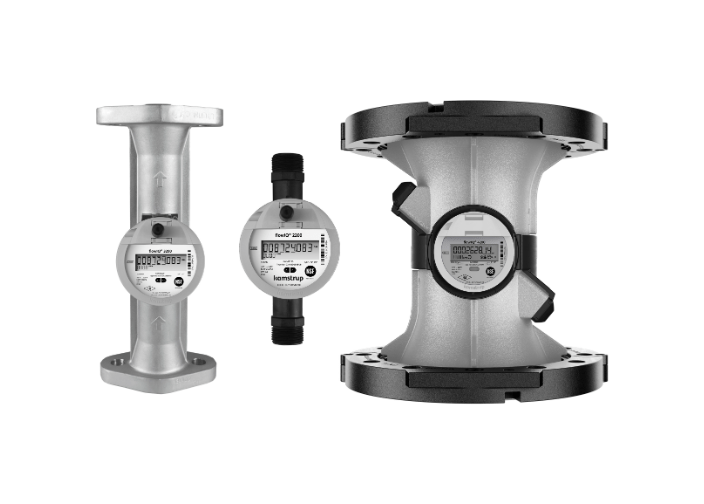
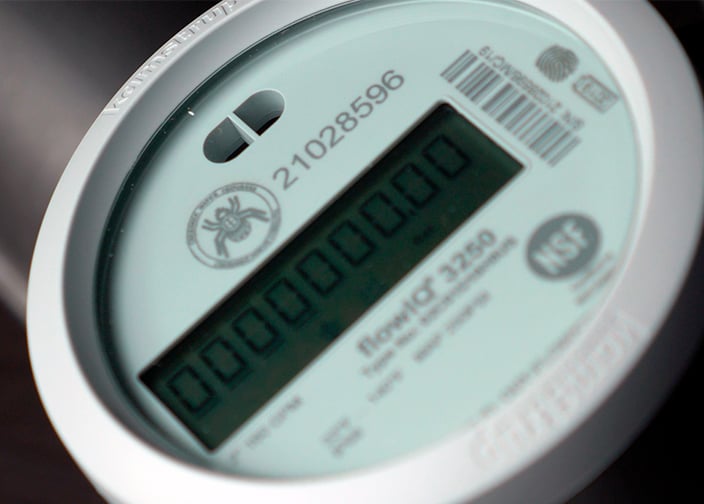
When selecting meter technology for effective NRW mitigation, ultrasonic meters stand out as the most accurate over their lifespan. Ultrasonic meters are static with no moving parts that wear out and no electrodes that can corrode. This design offers greater accuracy and minimizes degradation over years of use.
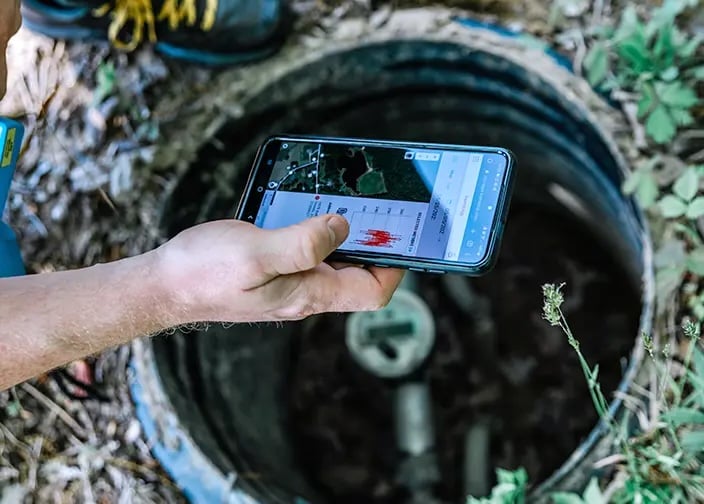
In addition, the ideal meter should be embedded with acoustic leak detection. This technology is not only capable of detecting leaks on the customer side but also can detect leaks upstream of the meter on the distribution side. Having acoustic leak detection in every meter offers unmatched saturation and density of listening capacity. Meters are located at virtually every curb stop in residential areas, providing coverage that would cost millions to achieve with traditional acoustic loggers. As an added benefit, with the meter being in the water column, sound from leaks travels further than it would through pipe walls, especially in plastic pipes (like PVC or HDPE).
Unlike traditional loggers that might listen once a day during quietest conditions, meters with embedded acoustic leak detection listen 26 times a day. This frequency allows the system to establish a unique sound floor for each location, allowing it to distinguish between normal and abnormal acoustic patterns. If a location’s typical noise value shifts significantly, it indicates a change, potentially a leak. Finally, the complex calculations for identifying baselines and changes are built into an algorithm within the meter software.
While meters are essential, they need not have every feature possible. For example, having a few strategically located pressure sensors throughout the system is far more effective than having such sensors embedded in the meter. These should be placed at critical points within a zone (the high point beyond the low point in a zone). A handful of dedicated pressure sensors can provide comprehensive coverage for an entire distribution zone with better accuracy and notification, especially when combined with a full deployment of meters equipped with acoustic leak detection. This is a more cost-effective strategy as well, given that few utilities have the budget to scatter pressure sensors, acoustic loggers, and more throughout the system.
While not required, implementing an AMI (advanced metering infrastructure) system is also a significant consideration. AMI technology can reduce labor costs associated with manual meter reading and provides more current and frequent data. For example, a good AMI system can deliver daily leak detection audits across an entire system, a level of detail not possible with manual or drive-by reading systems.
Setting Goals And Taking Action
With data and technology established, utilities should take a stair-step approach to NRW reduction targets. If an audit reveals, for example, a 25% loss, a realistic initial goal might be to drop below 20% within 12 months. Replacing antiquated meters with modern ultrasonic ones can conservatively yield between 3% and 7% increase in usage capture, increasing revenue. Achieving an initial 5% reduction in NRW is often easily attainable for utilities that have done little to identify their losses. Simple, quick fixes that don’t require significant time or money can yield real savings. Examples include repairing known surface leaks, addressing faulty hydrants, or fixing leaky valves. Re-evaluating and potentially adjusting pressure points can also lead to immediate improvements.
When it comes to leak detection, rapid response is key, and run time is a critical factor. A catastrophic main break, though releasing thousands of gallons per hour, might result in less overall loss if fixed within hours, compared to a small leak that persists for weeks, losing hundreds of thousands of gallons. Therefore, having an active program to find and fix both surface and hidden leaks is paramount.
Outreach and Education
Beyond technological and operational improvements, success in NRW reduction hinges on community involvement and education.
This should include:
• Informing the public about how non-revenue water impacts water availability and their water rates.
• Encouraging customers to report leaks and misuse of water.
• Engaging with customers to improve reporting of unauthorized connections, meter faults, and more.
• Partnering with local authorities to promote water conservation and infrastructure improvements.
In addition, they can consider incentive programs for community members to upgrade to water-saving fixtures like low-flow faucets, toilets, and showerheads.
Water Is Not Finite
While some regions may perceive themselves as “water-rich” and therefore be less concerned about NRW, this perspective overlooks the broader implications. Even with a surplus of water, production costs are constantly rising. Furthermore, if a utility also manages wastewater, the cost of treating water that wasn’t billed before going down the drain also increases, ultimately leading to higher rates for customers.
Conclusion
While some regions may perceive themselves as “water-rich” and therefore be less concerned about NRW, this perspective overlooks the broader implications. Even with a surplus of water, production costs are constantly rising. Furthermore, if a utility also manages wastewater, the cost of treating water that wasn’t billed before going down the drain also increases, ultimately leading to higher rates for customers.